Wednesday, December 30, 2020


Your Laughter


Take bread away from me, if you wish,
take air away, but
do not take from me your laughter.

Do not take away the rose,
the lance flower that you pluck,
the water that suddenly
bursts forth in joy,
the sudden wave
of silver born in you.

My struggle is harsh and I come back
with eyes tired
at times from having seen
the unchanging earth,
but when your laughter enters
it rises to the sky seeking me
and it opens for me all
the doors of life.

My love, in the darkest
hour your laughter
opens, and if suddenly
you see my blood staining
the stones of the street,
laugh, because your laughter
will be for my hands
like a fresh sword.

Next to the sea in the autumn,
your laughter must raise
its foamy cascade,
and in the spring, love,
I want your laughter like
the flower I was waiting for,
the blue flower, the rose
of my echoing country.

Laugh at the night,
at the day, at the moon,
laugh at the twisted
streets of the island,
laugh at this clumsy
boy who loves you,
but when I open
my eyes and close them,
when my steps go,
when my steps return,
deny me bread, air,
light, spring,
but never your laughter
for I would die.

Pablo Neruda


Sunday, April 26, 2020

Fable of the Mermaid and the Drunks


Fable of the Mermaid and the Drunks

All those men were there inside,
when she came in totally naked.
They had been drinking: they began to spit.
Newly come from the river, she knew nothing.
She was a mermaid who had lost her way.
The insults flowed down her gleaming flesh.
Obscenities drowned her golden breasts.
Not knowing tears, she did not weep tears.
Not knowing clothes, she did not have clothes.
They blackened her with burnt corks and cigarette stubs,
and rolled around laughing on the tavern floor.
She did not speak because she had no speech.
Her eyes were the colour of distant love,
her twin arms were made of white topaz.
Her lips moved, silent, in a coral light,
and suddenly she went out by that door.
Entering the river she was cleaned,
shining like a white stone in the rain,
and without looking back she swam again
swam towards emptiness, swam towards death.

~ Pablo Neruda

Friday, May 11, 2018


The Lake Isle of Innisfree

I will arise and go now, and go to Innisfree,
And a small cabin build there, of clay and wattles made;
Nine bean-rows will I have there, a hive for the honey-bee,
And live alone in the bee-loud glade.

And I shall have some peace there, for peace comes dropping slow,
Dropping from the veils of the morning to where the cricket sings;
There midnight’s all a glimmer, and noon a purple glow,
And evening full of the linnet’s wings.

I will arise and go now, for always night and day
I hear lake water lapping with low sounds by the shore;
While I stand on the roadway, or on the pavements grey,
I hear it in the deep heart’s core.


Tuesday, July 19, 2016


Travon Martin

Kids Who Die by Langston Hughes


This is for the kids who die,
Black and white,
For kids will die certainly.
The old and rich will live on awhile,
As always,
Eating blood and gold,
Letting kids die.
Kids will die in the swamps of Mississippi
Organizing sharecroppers
Kids will die in the streets of Chicago
Organizing workers
Kids will die in the orange groves of California
Telling others to get together
Whites and Filipinos,
Negroes and Mexicans,
All kinds of kids will die
Who don’t believe in lies, and bribes, and contentment
And a lousy peace.
Of course, the wise and the learned
Who pen editorials in the papers,
And the gentlemen with Dr. in front of their names
White and black,
Who make surveys and write books
Will live on weaving words to smother the kids who die,
And the sleazy courts,
And the bribe-reaching police,
And the blood-loving generals,
And the money-loving preachers
Will all raise their hands against the kids who die,
Beating them with laws and clubs and bayonets and bullets
To frighten the people—
For the kids who die are like iron in the blood of the people—
And the old and rich don’t want the people
To taste the iron of the kids who die,
Don’t want the people to get wise to their own power,
To believe an Angelo Herndon, or even get together
Listen, kids who die—
Maybe, now, there will be no monument for you
Except in our hearts
Maybe your bodies’ll be lost in a swamp
Or a prison grave, or the potter’s field,
Or the rivers where you’re drowned like Leibknecht
But the day will come—
You are sure yourselves that it is coming—
When the marching feet of the masses
Will raise for you a living monument of love,
And joy, and laughter,
And black hands and white hands clasped as one,
And a song that reaches the sky—
The song of the life triumphant
Through the kids who die.
Written in 1938.  Still too true today. (Angelo Braxton Herndon was an African-American labor organizer arrested and convicted for insurrection after attempting to organize black and white industrial workers alike in 1932 in Atlanta, Georgia)
Langston Hughes

Sunday, April 19, 2015

Two Proserpines

Proserpine by Hiram Powers at the Honolulu Museum of Art


Proserpine (or Persephone) is a character from Greek mythology who was forced to spend part of every year in the underworld. Her absence from the earth was believed to cause winter, while her return brought spring. Hiram Powers modeled the original bust of Proserpine to include an elaborate woven basket filled with flowers. This proved too time-consuming and expensive to carve, however, and it was changed to a simple arrangement of acanthus leaves. Proserpine was replicated more than any other work produced by an American sculptor during the nineteenth century, and Powers’s studio carved more than three hundred copies.

On a recent trip to Hawaii, I went to the Honolulu Museum of Art.  One of the photos I took was one of Prosperine.   The Museum was a lovely building with several courtyards with seating and plantings.  I enjoyed the collection.

This past weekend I was at the beautiful Milwaukee Art Museum.

Milwaukee Art Museum - The graceful Quadracci Pavilion is a sculptural, postmodern addition designed by Spanish architect Santiago Calatrava. Highlights of the building are the magnificent cathedral-like space of Windhover Hall, with a vaulted a 90-foot-high glass ceiling I
Imagine my surprise at encountering Prosperine again so soon!

Proserpine by Hiram Powers at Milwaukee Art Museum

 The museum's notes say: 
"Despite Hiram Powers receiving limited training in his native Cincinnati, his talent as a sculptor captured the attention of local collectors and wealthy patrons able to finance his travels to the East Coast and Europe.. Powers eventually settled in Florence and embraced Neoclassicism, a style indebted to the art of ancient Greece and Rome and its subject matter.  In this second of three versions the artist created the Roman Goddess Proserpine, the mythical daughter of Ceres, he depicts her rising out of ornamental acanthus blossoms, a symbol of her mortality and a promise of the return of spring and summer each year.  Due to the sculpture’s popularity and high demand from enthusiastic clients, Power’s studio produced some three hundred copies."

How timely that I discover more about Prosperine (or Persephone, the name I was more familiar with) in the spring of the year in two places!

Thursday, April 24, 2014

Juxtaposition

Things Found While Looking Around


Frida Kahlo photographed for US Vogue, in October 1937, in her folkloric costume.

Frida Kahlo's fame lives on more than 60 years after her untimely death in 1954.  Her personal style included folkloric outfits from many parts of Mexico as well as Mexican and Pre-Colombian jewelry.  Many photos exist of her including this one taken for Vogue which is a nod back to the work of Jesús Helguera


No way to tell which of these was first but Helaguera was working from an early age starting at 18 in 1928, so it is entirely possible his work with the lady in a pink skirt came before Frida's iconic portrait.  Something to think about...


Thursday, August 8, 2013

Same Girl ~ Two Artists

Same Girl ~ Two Artists
Female Artist ~ Ernst Ludwig Kirchner & 
Girl on a Green Sofa With a Cat- Max Pechstein

“Think about how that Pechstein, who learned with hat in hand, and after five years came to you and threatened: ‘If you speak against me in public, I will make it so that no one else will look at your work and you can go hungry.’ And you laughed in his face, and rightly, but still it was bitter because the opposite was the case….”
- Ernst Ludwig Kirchner (adressing himself), Davoser Tegebuch (July 6, 1919)

Wednesday, March 13, 2013

To A Kiss

Paris, 2007


Humid seal of soft affections,
Tend'rest pledge of future bliss,
Dearest tie of young connections,
Love's first snow-drop, virgin kiss.
Speaking silence, dumb confession,
Passion's birth, and infants' play,
Dove-like fondness, chaste concession,
Glowing dawn of brighter day.
Sorrowing joy, adieu's last action,
Ling'ring lips, -- no more to join!
What words can ever speak affection
Thrilling and sincere as thine!

~ Robert Burns

Saturday, March 2, 2013

Poem #14


Every day you play with the light of the universe.
Subtle visitor, you arrive in the flower and the water.
You are more than this white head that I hold tightly
as a cluster of fruit, every day, between my hands.

You are like nobody since I love you.
Let me spread you out among yellow garlands.
Who writes your name in letters of smoke among the stars of the south?
Oh let me remember you as you were before you existed.

Suddenly the wind howls and bangs at my shut window.
The sky is a net crammed with shadowy fish.
Here all the winds let go sooner or later, all of them.
The rain takes off her clothes.

The birds go by, fleeing.
The wind. The wind.
I can contend only against the power of men.
The storm whirls dark leaves
and turns loose all the boats that were moored last night to the sky.

You are here. Oh, you do not run away.
You will answer me to the last cry.
Cling to me as though you were frightened.
Even so, at one time a strange shadow ran through your eyes.

Now, now too, little one, you bring me honeysuckle,
and even your breasts smell of it.
While the sad wind goes slaughtering butterflies
I love you, and my happiness bites the plum of your mouth.

How you must have suffered getting accustomed to me,
my savage, solitary soul, my name that sends them all running.
So many times we have seen the morning star burn, kissing our eyes,
and over our heads the gray light unwind in turning fans.

My words rained over you, stroking you.
A long time I have loved the sunned mother-of-pearl of your body.
I go so far as to think that you own the universe.
I will bring you happy flowers from the mountains, bluebells,
dark hazels, and rustic baskets of kisses.
I want
to do with you what spring does with the cherry trees.

From 20 Love Poems and a Song of Despair ~ Pablo Neruda


Friday, January 4, 2013

Message in a Chocolate Bar

Chocolove Almonds & Sea Salt in Dark Chocolate


Message in a Chocolate Bar

With Christmas, came a chocolate bar.  Delicious, but not just.  When you check the cover, the small note promises "love poem inside"  Lovely added value:


A Magic Moment I Remember

A magic moment I remember:
I raised my eyes and you were there,
A fleeting vision, the quintessence
Of all that's beautiful and rare.

I pray to mute despair and anguish,
To vain pursuits the world esteems,
Long did I near your soothing accents,
Long did your features haunt my dreams.

Time passed. A rebel storm-blast scattered
The reveries that once were mine
And I forgot your soothing accents,
Your features gracefully divine.

In dark days of enforced retirement
I gazed upon grey skies above
With no ideals to inspire me,
No one to cry for, live for, love.

Then came a moment of renaissance,
I looked up - you again are there,
A fleeting vision, the quintessence
Of all that`s beautiful and rare.
 Alexander Pushkin

Alexander Pushkin

Wednesday, December 19, 2012

Snowflakes

 
Snowflakes
 
Out of the bosom of the Air.
Out of the cloud-folds of her garments shaken,
Over the woodlands brown and bare,
Over the harvest-fields forsaken,
Silent and soft and slow
Descends the snow. Even as our cloudy fancies take
Suddenly shape in some divine expression,
Even as the troubled heart doth make
In the white countenance confession,
The troubled sky reveals
The grief it feels
This is the poem of the air,
Slowly in silent syllables recorded;
This is the secret of despair,
Long in its cloudy bosom hoarded,
Now whispered and revealed
To wood and field.


Henry Wadsworth Longfellow


Thursday, December 13, 2012

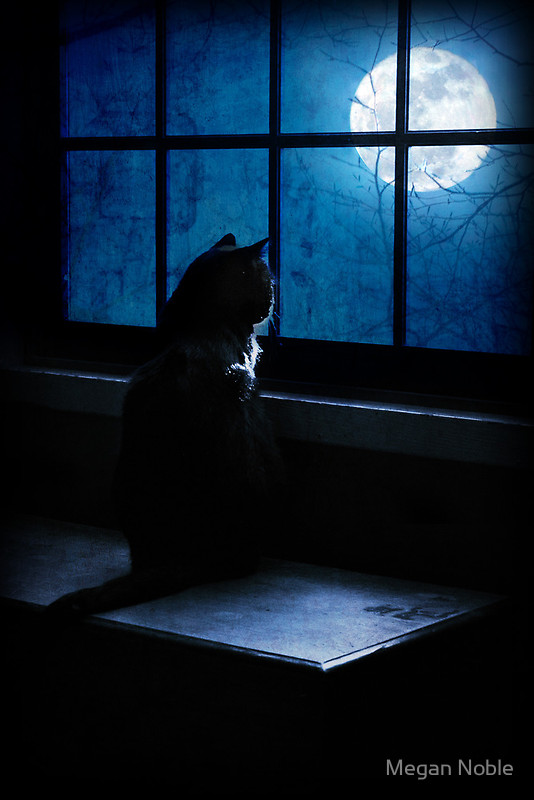
The cat and the moon


The cat and the moon

The cat went here and there
And the moon spun round like a top,
And the nearest kin of the moon,
The creeping cat, looked up.
Black Minnaloushe stared at the moon,
For, wander and wail as he would,
The pure cold light in the sky
Troubled his animal blood.
Minnaloushe runs in the grass
Lifting his delicate feet.
Do you dance, Minnaloushe, do you dance?
When two close kindred meet,
What better than call a dance?
Maybe the moon may learn,
Tired of that courtly fashion,
A new dance turn.
Minnaloushe creeps through the grass
From moonlit place to place,
The sacred moon overhead
Has taken a new phase.
Does Minnaloushe know that his pupils
Will pass from change to change,
And that from round to crescent,
From crescent to round they range?
Minnaloushe creeps through the grass
Alone, important and wise,
And lifts to the changing moon
His changing eyes.
-- William Butler Yeats 

Tuesday, October 23, 2012

Girl at Sewing Machine


Edward Hopper, Girl at a Sewing Machine

Girl at Sewing Machine

(after a painting by Edward Hopper)
Mary Leader

It must be warm in the room, walls the color of over-steeped tea,
the sun high,
coating the yellow brick exterior of the apartment building,
angling in on
the girl, stripped down to camisole and petticoat, sewing.
She's a busty girl,
soft, no doubt perspiring, slippery under her breasts, moisture
trapped on the back
of her neck under all that chestnut hair. She doesn't notice,
though; you can see
she's intent on her seam. She doesn't slump over the machine
but bends from the hip,
her body as attuned as her hands. Her feet, though not shown
in the painting,
are bound to be pudgy, are probably bare, pumping the treadle
ka-chunk ka-chunk ka-chunk
but that's unconscious. Her point of concentration is the needle,
silver, quick,
its chick chick chick chick chick, necessity to keep the material
in perfect position,
position. What is she making? The fabric looks heavy and yet
billowy, like
whipped cream, or cumulus clouds; certain girls, while large, move
with grace (when nobody's
there) but in public, conceal, or try to conceal, their bodies
beneath long clothes.
They favor long hair, feeling it wimples and veils embarrassment.
Yes, I know this girl.
Only in her room, only when unseen, can she relax at all, peel off
a hot blouse,
a brown skirt, like the one heaped on her bed in the background,
take pleasure in
a good hairbrush, the bottle of scent on the dresser, the picture
of her own choosing
on the wall. Whatever she's making--let's go ahead and say it's
a dress for herself--
she is not, as you might think, dreaming of a party, a dance,
or a wedding. No, she's
deciding to flat-fell that seam--time-consuming, but worth it--
stronger, better-looking.
I'm sure she knows by now not to expect much attention from boys.
She's what? twenty?
eighteen? She will, in time, use many words to describe herself,
not all of them bad;
but not once will one of them be "pretty," or "lovely." Those
aren't for a fat girl
though she can take a mass of cloth, and a cast-iron machine,
and make a beautiful shape.

I heard this poem on Garrison Keilor's  The Writer's Almanac quite a while ago and just discovered the painting on Pinterest.  I thought they would go together well without realizing that the painting was the inspiration for the poem. Thanks to the internet, they are together here!

Monday, May 28, 2012

Huexotzincatzin Prince of Texcoco, 1484

Inspired By Flowers by Richard Dunkley


Ustedes Me dicen, entonces que tengo que perecer...
como también las flores que cultivé perecerán.

¿De mi nombre nada quedará, nadie mi fama recordará?

Pero los jardines que planté son jóvenes y crecerán...

Las canciones que cante ¡Cantándose seguirán!

Huexotzincatzin
Príncipe de Texcoco, 1484


Must I go on just like this
like the flowers that perish?

Will nothing remain of my name?

Nothing of my fame here on earth?

At least flowers, at least songs!

Huexotzincatzin
Prince of Texcoco, 1484

Inspired By Flowers. by Richard Dunkley

I found this poem in an airline magazine, on my way to Mexico.  The article said this poem was on the wall of the Museo de Antropologia in Mexico City. I liked it so much, I wanted to see it and also had neglected to rip of the magazine.  I got in a taxi and told the taxi driver about the poem and off we went.  We didn't find the poem on the wall but he had a copy of Azteca that he was reading and this very poem was on the front page.  Serendipitous?  I think so!

Thursday, May 17, 2012

Sleepwalking


In front of the refrigerator
Lighting the darkness,
Leftovers, cheese rind
Milk past the expiration date
Wrinkled plums
Trying to fill myself
With what’s missing
Love, companionship, encouragement
In my sleep, standing, swaying, eating
Dreaming of banishment, betrayal, shame
Praying, wishing, hoping
In my sleep…

Saturday, March 31, 2012

I confess...

Magnolia Tree Before and After

May I just first say, I'm a hobby picture taker.  Just out snapping for my own pleasure.  But, I love Photoshop.  I spend a lot of time tweaking my photos before posting them on Flickr.  I don't think it's anything new.  Photographers have been altering photos to suit their vision for quite some time.  Ansel Adams said: "Dodging and burning are steps to take care of mistakes God made in establishing tonal relationships."  I think he would have really loved Photoshop.
When we're out shooting, the beauty carries us away.  The light! The color! The textures!  We merrily snap the shutter and miss the telephone wires, the fire hydrants. the parking meters, the hot mess of old dead ivy.
So I clone stuff out.  I jack up the colors.  I play with shadows and mid-tones and stuff until I have the photo I saw when I snapped the shutter.  Don't judge me.  I can't help myself.  Of course, I have my limits.  I still prefer the photo looks like something a person would recognize as something their eyes might actually see.  I've seen some amazing things done with High Dynamic Range.  Per Wikipedia: "...HDR is a range of techniques geared toward representing more contrast in pictures. Non-HDR cameras take pictures at a single exposure level with a limited contrast range. This results in the loss of detail in bright or dark areas of a picture, depending on whether the camera had a low or high exposure setting. HDR compensates for this loss of detail by taking multiple pictures at different exposure levels and intelligently stitching them together so that we eventually arrive at a picture that is representative in both dark and bright areas."  In the wrong hands this can go wrong in way too many ways:
High Dynamic Range Mashup
Fortunately, there's lots of fun stuff one can do in Photoshop:

Spring branches tarted up with texture, etc.
I love to work in textures and layers.
Rapture of the Deep
I made an entire sketchbook of these for the Sketchbool Project.
It was very much fun.
Sometimes I just make collages for myself:
"When you fish for love, bait with your heart, not your brain" ~ Mark Twain
 Sometimes it's for a purpose:
"Through the Fire"
This image was for a benefit for breast cancer.  Portraits thought to show women with breast cancer, Diagnostic images of cancer. Molecules of Fluorouracil, Cyclophosphamide and Methotrexate used in chemotherapy for breast cancer.

Here's one for a show called "Dark":
Falling
Spring Greetings!
Peeps in Paradise
Happy Spring, everyone!

Sunday, February 5, 2012

Writer's Workshop

Lynda Barry

 Today, I had the good fortune to attend a Lynda Barry workshop: Writing the Unthinkable.  I think she has been doing this workshop for a while.  I see others who have taken it talking about it.  She is interested in what an image is in a deeper way and the process of writing with a pen or pencil on paper and how the brain is engaged when we do this.

She shares a process she uses to access memories and hone them into a perfect short story just about the right length for a comic strip.  It seems to work very well.  Many people read their seven and a half minutes stories and they were fresh and tasty!
My Wonky Spiral
 Part of the exercise is to sit and make a spiral on a blank page while she recites Rumi and reminds us we are in our bodies.  The poem is beautiful and I was grateful to be introduced to it.  She recited it about four times for us and I will carry it with me now and it feels like a gift.

Thanks you Lynda Barry!

Waves on the beach


THE DIVER'S CLOTHES LYING EMPTY
You're sitting here with us, but you're also out walking
in a field at dawn. You are yourself
the animal we hunt when you come with us on the hunt.
You're in your body like a plant is solid in the ground,
yet you're wind. You're the diver's clothes
lying empty on the beach. You're the fish.

In the ocean are many bright strands
and many dark strands like veins that are seen
when a wing is lifted up.
Your hidden self is blood in those, those veins
that are lute strings that make ocean music,
not the sad edge of surf, but the sound of no shore.
Jalāl ad-Dīn Muḥammad Balkhī (Rumi)

Rumi

Saturday, December 17, 2011

Wild Geese

Crescent Moon and Wild Geese 
by
Utagawa Hiroshige
Wild Geese

You do not have to be good.
You do not have to walk on your knees
for a hundred miles through the desert repenting.
You only have to let the soft animal of your body
love what it loves.
Tell me about despair, yours, and I will tell you mine.
Meanwhile the world goes on.
Meanwhile the sun and the clear pebbles of the rain
are moving across the landscapes,
over the prairies and the deep trees,
the mountains and the rivers.
Meanwhile the wild geese, high in the clean blue air,
are heading home again.
Whoever you are, no matter how lonely,
the world offers itself to your imagination,
calls to you like the wild geese, harsh and exciting 
over and over announcing your place
in the family of things.

from Dream Work by Mary Oliver 
Wild Geese 
by
Maxfirle Parrish

Friday, December 16, 2011

Christkindlmarket


A couple of weeks ago, we went to Christkindlmarket Chicago.  It's a little bit of Gemany right downtown at Daly Plaza.

"Inspired by the Christkindlesmarkt in Nuremberg, Germany, which began in 1545, the Christkindlmarket Chicago brings a cherished German and European tradition with international flair and local charm to Chicago. Chicago's largest open-air Christmas festival was first held on Pioneer Court in 1996. By special invitation of Mayor Richard M. Daley, Christkindlmarket Chicago moved to Daley Plaza in 1997 and has become a stable event on the plaza ever since. Together with the support of the Mayor’s Office of Special Events (MOSE), Christkindlmarket Chicago has grown to become one of the most popular winter attractions in the heart of the city."

I had long thought that Christmas would be a wonderful time to visit Germany.  When I had the opportunity to visit at Thanksgiving a couple of years ago, we had to go the the Christmas markets.  The Christkindlmarket Chicago conjures up memories of this visit.


Christkindlmarket Chicago Chicago offers many of the same things you would find in Germany like  ornaments that are hand-blown and painted, classic German products like nutcrackers, cuckoo clocks, and beer steins.  We really liked the ornaments.  There was a whole store full of glass ornaments:

Lucky Piggies
Bathtime Duckies
Shiny Pink Booties
Berlin Medallions 
Sweet Mushroom Fairies

Snacks at the market

You can warm up with some nice soup or potato pancakes, or a bratwurst.  Traditional Gluehwein, a  German holiday market hot spiced wine comes in a commemorative mug shaped like a boot!
So, if you want to pretend you are in Germany at Christmastime for a couple of hours, head to Christkindlmarket Chicago!